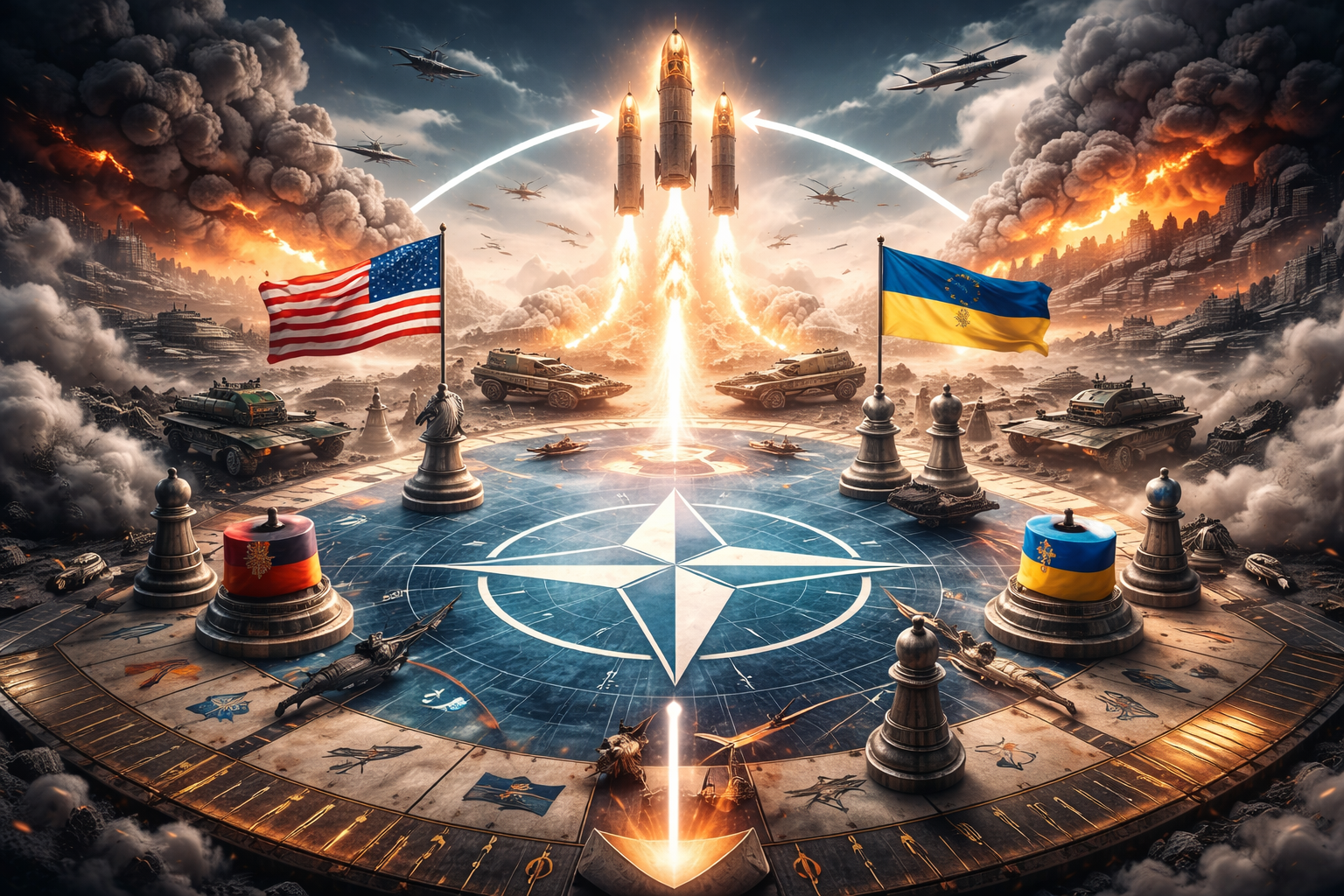
The final phase of the conversation addresses the most difficult “what if” scenarios of the conflict. It examines why the United States hasn’t ended the war directly, whether a more competent invader could have succeeded, and why raw brutality—like mass bombing—rarely produces the desired strategic outcome.
The Escalation Ladder and Indirect Intervention
A central question in the war is why the United States, with its overwhelming military superiority, does not intervene to end the conflict immediately. Game theory explains this through the Escalation Ladder. In a conflict between two nuclear-armed peers, every move is calculated to avoid “vertical escalation” (the move from conventional to nuclear weapons).
If the U.S. were to enter the war directly, it would likely achieve a rapid tactical victory on the ground. However, this creates a rational crisis for Russia:
If Russia accepts a conventional defeat at the hands of NATO, the regime likely collapses.
To avoid collapse, Russia may perceive “tactical nuclear use” as a rational move to force NATO to back down.
Because the payoff of a nuclear exchange is catastrophic for everyone, the U.S. chooses a strategy of Restraint. By providing weapons to Ukraine rather than sending troops, the U.S. keeps the conflict on a lower rung of the escalation ladder. This makes the war longer and more painful, but it preserves the global equilibrium of avoiding total annihilation.
The Competence Trap: Could the U.S. have done it better?
A common counterfactual asks: “If the U.S. had been the invader (in Russia’s position), would they have won quickly?” Game theory suggests that while the U.S. would have avoided the logistical “fuel failures” Russia experienced, they would have likely hit the same Political Wall.
Military competence can win battles and capture terrain, but it cannot force compliance. In game theory, an invasion is a “coercion game.” For the invader to win, the defender must conclude that surrendering is better than fighting.
If the defender (Ukraine) views the invasion as existential (a threat to their very identity), then no amount of military competence makes surrender a rational choice.
Even if the U.S. had captured Kyiv in 48 hours, they would have likely inherited a permanent, decentralized insurgency that is impossible to “win” in a traditional sense.
The Fallacy of “Bombing into Submission”
If an invasion stalls, the next intuitive move is to use overwhelming force—bombing—to break the opponent’s will. However, game theory and historical data show that this strategy often produces the opposite of the intended effect.
For bombing to produce submission, it must make the population believe that “if we stop fighting, the pain will stop.” But when an attacker bombs civilian infrastructure, the population updates its beliefs: they see the attacker as an unconditional enemy.
The Defender’s Payoff: If they believe the attacker intends to destroy them regardless of what they do, the “cost” of resisting becomes lower than the “cost” of surrendering.
Third-Party Effects: Mass bombing also changes the payoff for outside observers (like the West), making it more “profitable” for them to intervene with more advanced weapons to stop the perceived atrocity.
Russia’s failure to “bomb Ukraine into submission” was not just a lack of planes; it was a realization that doing so would have destroyed the very territory they wanted to govern while ensuring that the Ukrainian people would never accept Russian rule.
Final Synthesis: The Strategic Verdict
The entire conversation demonstrates that Game Theory is not just about being “smart” or “selfish.” It is about understanding that outcomes are restricted by the rules and incentives of the system. Russia’s outcome was not just a result of “bad luck” or “bad soldiers.” It was the result of choosing a strategy (invasion) that destroyed the possibility of a peaceful negotiation (the bargaining equilibrium) and replaced it with a fight for survival. Once a game becomes about survival, force loses its efficiency, and the conflict becomes a test of endurance rather than a test of cleverness.


