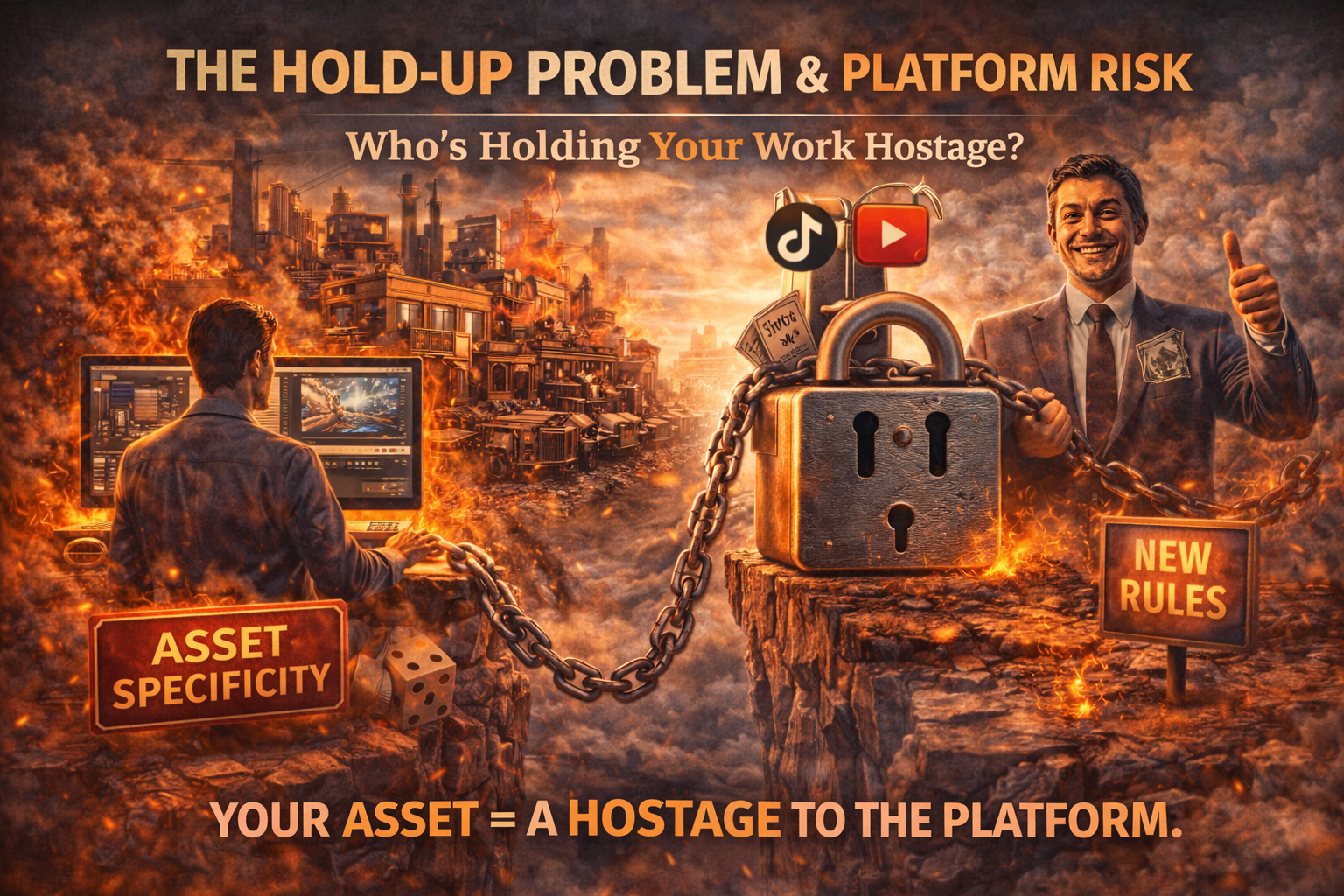
The “Hold-Up” problem is a classic strategic trap that occurs after a deal is signed but before the project is finished. It happens when one party makes a deep, specialized investment that is only valuable within that specific relationship. Once that investment is “sunk,” the other party gains massive leverage and can “hold you up” by demanding a change in the rules to their advantage.
- Asset Specificity
The root of the hold-up problem is Asset Specificity. This refers to an investment that cannot be easily repurposed for another use or another “game.”
The Manufacturing Example: If you build a factory with specialized machinery designed solely to make parts for one specific car company, your asset is highly specific. Once the factory is built, you are locked in. The car company can come back and demand lower prices, knowing your factory is essentially useless to any other buyer. They are no longer negotiating with a competitor; they are squeezing a hostage.
Application: This is the primary risk for modern digital creators. If you build a following exclusively within one social media algorithm, your “asset” (your audience) is highly specific to that platform. If the platform changes the monetization rules or suppresses your reach, you cannot simply “move” that asset to a different game. Your years of work are held hostage by the platform’s code.
Part 4 Reinforcement: The Reality Check
The Hold-Up problem is particularly dangerous because it exploits the structural failures of long-term planning.
Time-Horizon Mismatch: This is the most common cause of the hold-up. You might make an investment with a 10-year horizon (building a brand or a factory), assuming the rules of the game will stay stable. However, the other party—like a platform or a corporate partner—might be optimizing for a one-quarter profit boost. They are willing to destroy the long-term equilibrium of the relationship to hit a short-term target. Because their time-horizon is shorter than yours, they have the “power of the present” to change the rules.
The Information Gap: The hold-up often relies on Incomplete Information. When you started the investment, you might have believed the partner was “reliable.” But because you couldn’t see their internal “map” or their looming financial desperation, you didn’t realize they were a “Hawk” disguised as a “Dove.” You optimized your strategy based on a hallucinated belief in their long-term stability.
Misidentifying the Game: You may think you are playing a Cooperative Repeated Game, where both sides benefit from long-term trust. But the other side may realize that at a certain point, the “payoff” for defecting (the hold-up) is higher than the payoff for continued cooperation. They switch games mid-stream, moving from a “partnership” to a “shakedown.”
The Complexity Ceiling: In modern tech ecosystems, the “rules” of the game are often so complex (managed by black-box AI algorithms) that it is impossible to calculate the Nash Equilibrium. You are making specific investments in a system where the rules can change without any human being even intending to hold you up.
The Key Takeaway
To avoid the hold-up, you must diversify your assets or vertically integrate. If your asset can be used in multiple games, you have an exit option. If your asset is 100% specific to one partner, you aren’t an owner—you’re a subcontractor waiting for the rules to change.


