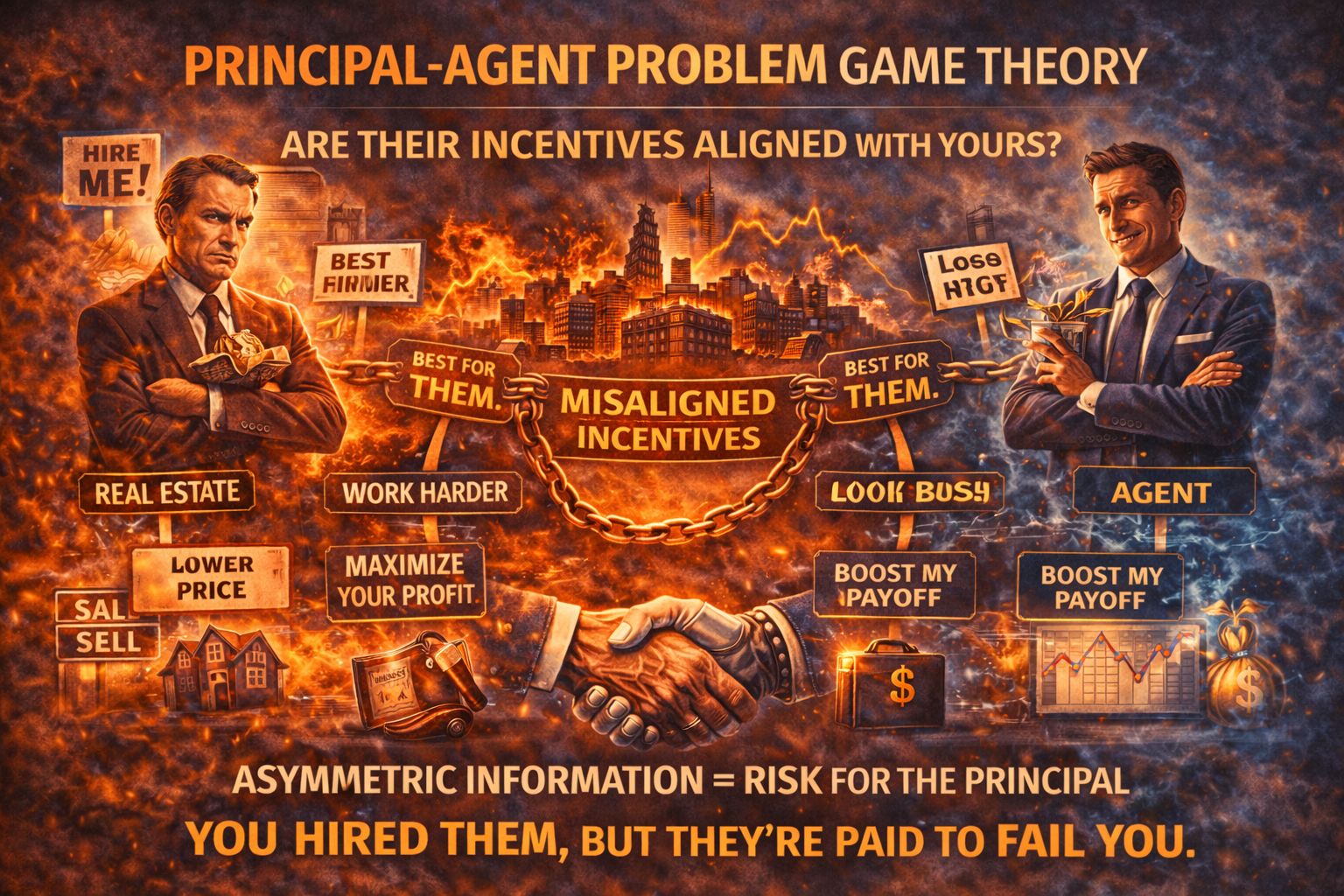
The Principal-Agent problem arises whenever one person (the Principal) hires another person (the Agent) to act on their behalf. In a world of perfect trust, the Agent would act exactly as the Principal would. In the real world of game theory, the Agent has their own payoff matrix, and their incentives are almost never perfectly aligned with yours.
- The Gap
The “Gap” is the difference between what is best for you and what is best for the person you hired. Because the Agent often has more information than the Principal (Asymmetric Information), they can prioritize their own payoff without you even realizing it.
Real Estate: Your agent wants a quick sale to collect their commission and move to the next client. You want the highest possible price for your equity, even if it takes six months of waiting.
Legal: Your lawyer may want more billable hours or a trial for the experience; you likely want a fast, quiet settlement to minimize costs and stress.
Corporate: A CEO (Agent) might take massive risks to boost the stock price for a year-end bonus, while the shareholders (Principals) want the company to be stable for the next decade.
Part 4 Reinforcement: The Reality Check
The Principal-Agent problem is the ultimate “hidden game,” and it thrives on the failure points we identified in Part 4.
Misidentifying the Game: This is the most common management failure. You think you are playing a Team Game with your employees—where everyone wins if the project succeeds. But the employees might be playing a Personal Career Game. In their game, the best move isn’t to be productive; it’s to look busy, avoid blame, and check boxes that lead to a promotion. If you don’t realize you’re playing different games, your “leadership” is just noise.
The Information Gap: The Agent almost always has the “better map.” A mechanic knows more about your car than you do; a fund manager knows more about the market. This gap allows the Agent to “hallucinate” a necessity (e.g., “you need a new transmission”) to increase their own payoff. If you can’t verify the map, you can’t control the Agent.
The Rationality Assumption: We often assume that “professionalism” or “ethics” will make the Agent rational on our behalf. However, game theory suggests that Agents will rationally optimize for their own Utility (Part 4)—which might include leisure, status, or job security—over your profit. If you don’t account for their personal utility, you will be constantly surprised by their “lack of loyalty.”
Time-Horizon Mismatch: You are playing for the long-term survival of your house or business. The Agent might be playing for a one-time commission. When time-horizons don’t match, the Agent is incentivized to “burn” your long-term value for their immediate gain.
The Key Question
To bridge the gap, stop relying on trust and start looking at the mechanics of the payout. Ask: “How does this person get paid if they fail me?” If the Agent still gets paid (or even gets paid more) when you lose, you haven’t hired a partner—you’ve funded a predator.


