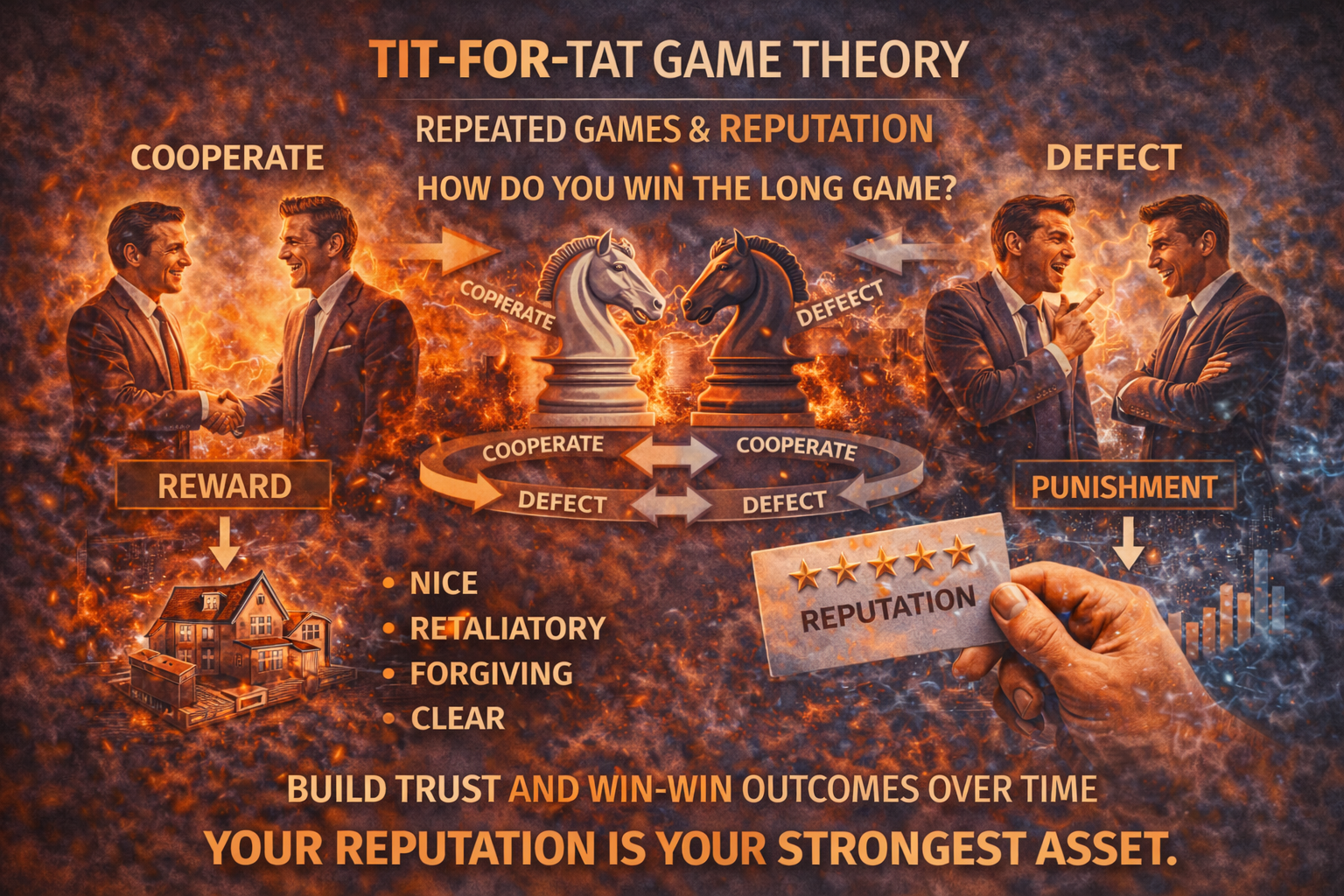
In a single-shot game, selfishness often pays. But life is rarely a single-shot game; it is a series of repeated interactions. When you play the same game with the same people over and over, your “Reputation” becomes a tangible asset. In this environment, the most successful strategy ever discovered—proven by computer simulations and evolutionary biology—is Tit-for-Tat.
- Be Nice, but Provocable
The rules of Tit-for-Tat are deceptively simple: Start by cooperating, then simply copy the opponent’s last move. If they cooperate, you cooperate. If they defect, you defect in the next round.
This strategy dominates because it possesses four specific traits:
Nice: It never starts a fight. It opens the door for a high-payoff “Win-Win” equilibrium from the very first move.
Retaliatory: It prevents you from being “exploited” by Hawks (Part 9). If the other side tries to take advantage of you, they are immediately punished.
Forgiving: It doesn’t hold a grudge. If the opponent stops defecting and starts cooperating again, Tit-for-Tat immediately returns to cooperation.
Clear: It is predictable. The opponent doesn’t have to guess your “map” or your intent. They know exactly how you will react, which makes it easy for them to choose to cooperate.
Part 4 Reinforcement: The Reality Check
Tit-for-Tat is the gold standard of game theory, but it is highly sensitive to the “noise” and “errors” we discussed in our failure points.
The Rationality Assumption: Tit-for-Tat assumes the other player is paying attention, is rational, and can accurately read your moves. In the real world, people make mistakes. If you “retaliate” against someone who didn’t mean to defect (perhaps they had a logistical failure like the Russian fuel trucks in Part 2), you can trigger a “death spiral” of mutual destruction. You defect because you think they did; they defect because you did. Neither side wanted a war, but you are now locked in one because of a single error in the “map.”
The Information Gap: Tit-for-Tat relies on seeing the other person’s move clearly. In many games (like corporate politics or “hidden” negotiations), it’s hard to tell if someone actually “betrayed” you or if they were just constrained by their own Principal-Agent problems (Part 12). If your intelligence is bad, you might retaliate against an ally, destroying a long-term equilibrium based on a hallucination.
Time-Horizon Mismatch: Tit-for-Tat only works if both players believe the game will continue indefinitely. If one player knows the game is about to end (the “Last Period Problem”), they have a massive incentive to defect on the final move. If you are playing for a 10-year relationship but they are playing for a “one-time exit,” Tit-for-Tat will leave you exposed to a final, devastating “Hold-Up” (Part 8).
Complexity Ceiling: In a 1-on-1 game, Tit-for-Tat is easy. In a game with 100 players, it becomes a nightmare. If you retaliate against one person, do the others see you as “strong” or as a “Hawk”? The complexity of social reputation makes “simple” strategies much harder to execute without accidentally signaling the wrong intent.
The Key Question
When entering a new relationship or market, stop asking how you can “beat” the other person and ask: “Will I ever see this person again?” If the answer is yes, then Tit-for-Tat isn’t just a nice way to act—it is the mathematically optimal path to the highest long-term payoff.


