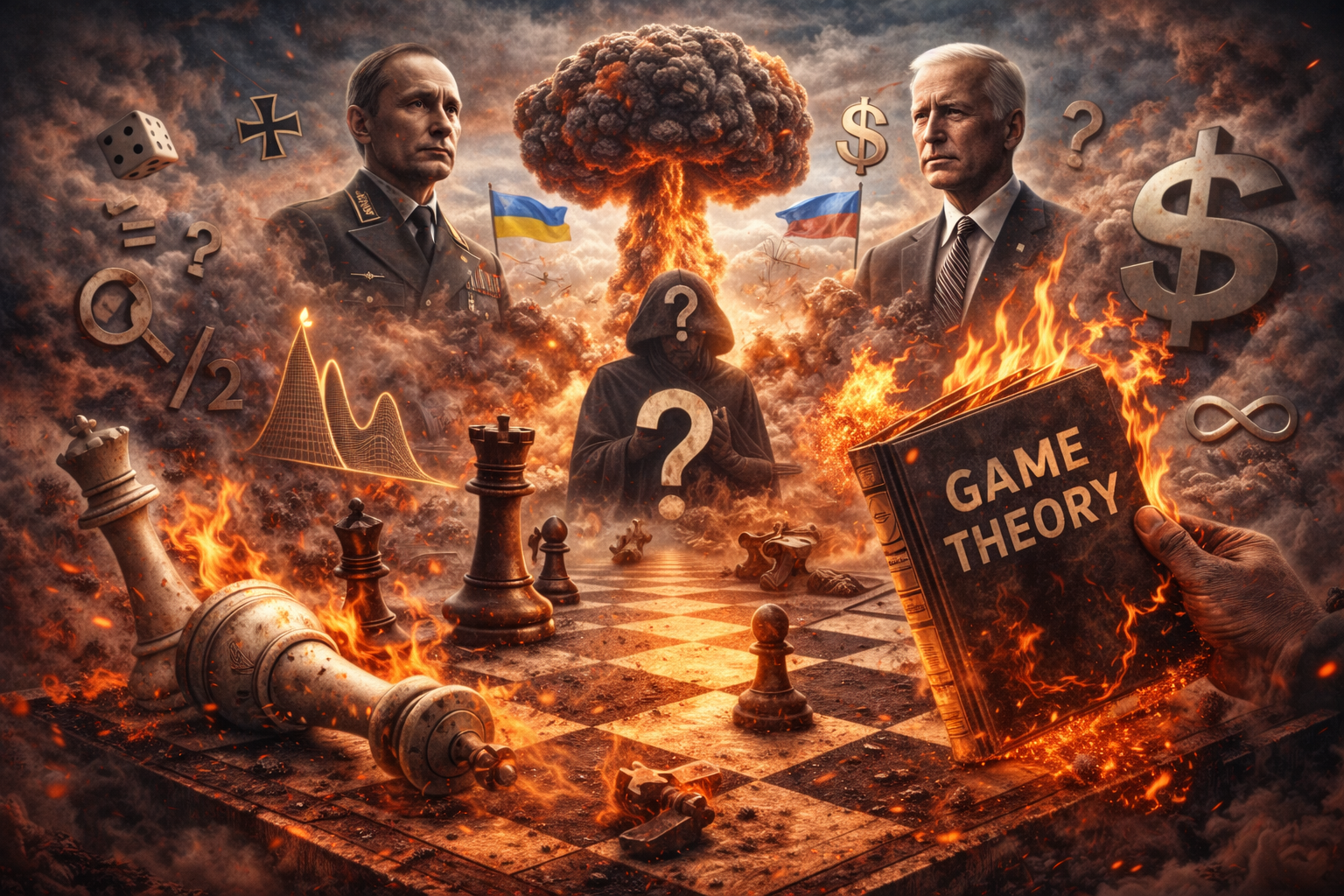
If game theory is so powerful, why isn’t every game theorist a billionaire or a world leader? Because game theory is a mathematical model, and models are only as good as their assumptions. In the real world, the “clean” logic of a payoff matrix often collides with the “messy” reality of human biology and environmental chaos.
To use game theory effectively, you must know when to stop using it.
- The Rationality Assumption
Game theory assumes players are “rational,” meaning they have clear preferences and consistently act to maximize their own payoff.
The Reality: Humans have “bounded rationality.” We get tired, we get angry, and we are terrible at calculating probabilities in our heads.
The Failure: If you play a game assuming your opponent is a cold, calculating machine, but they are actually acting out of spite or a misunderstood religious belief, your “optimal” strategy will fail. You cannot solve a game if you don’t actually know what the other person values. - The Information Gap
Standard models often assume “Common Knowledge”—I know the rules, you know the rules, and I know that you know that I know the rules.
The Reality: Most real-world games are played in a fog. In the Russia-Ukraine war, Russia’s “game” failed partly because they had bad intelligence. They were playing a game based on the belief that the Ukrainian government would flee.
The Failure: If your input data is wrong, the game-theoretic output is a “hallucination.” Game theory optimizes the map, but it cannot fix a map that is fundamentally incorrect. - The Complexity Ceiling
Game theory works best in “closed” systems with a limited number of players and moves.
The Reality: Life is an Open Game. New players enter constantly, the “rules” change mid-game, and the payoff matrix is influenced by billions of external variables (weather, stock market crashes, a random tweet).
The Failure: When there are too many variables, the “Nash Equilibrium” becomes impossible to calculate. This is why game theory is great for a 1-on-1 negotiation, but often fails to predict the behavior of an entire macroeconomy. - The “Utility” Problem
Game theory assumes we can assign a number (utility) to an outcome.
The Reality: How do you quantify the “payoff” of honor, or the “cost” of a guilty conscience?
The Failure: If you define “winning” as “making the most money,” but your opponent defines “winning” as “dying for a cause,” your model is broken. This is why powerful nations often lose to insurgencies—they are playing for “territory” while the opponent is playing for “eternity.” - The Limit of Equilibrium
An equilibrium is a static state. It assumes the game has reached a point where no one wants to move.
The Reality: Most interesting parts of life happen during disequilibrium. Markets move because people are not in equilibrium; they are panicking, innovating, or making mistakes.
The Failure: If you only look for the stable outcome, you will miss the “disruption” that happens when someone flips the table and starts a new game entirely. - The Level-Zero Failure: Misidentifying the Game
The most catastrophic failure in game theory isn’t making a bad move; it’s making a move in the wrong game. This happens when you assume your opponent shares your goals, or at least your understanding of the stakes.
The Reality: In business, you might think you’re in a Competitive Game (trying to gain market share), while your rival is playing a Predatory Game (trying to bankrupt you, regardless of their own profit).
The Failure: If you play a “rational” strategy for Game A while your opponent is playing Game B, your “optimal” move becomes a self-inflicted wound. - The Time-Horizon Mismatch
Game theory often assumes a fixed end-point or a consistent time-horizon for all players.
The Reality: One player might be playing for the Next Quarter (a CEO seeking a bonus), while the other is playing for the Next Century (a family-owned business or a nationalist movement).
The Failure: The player with the longer time-horizon will almost always win an attrition game, even if they have fewer resources. They are willing to accept “negative payoffs” today for a victory fifty years from now.
Summary of the “Part 4” Reality Check
To use the framework going forward, you must use these “Failure Points” as a filter. Before you draw a payoff matrix, you have to ask:
Am I projecting my own rationality onto them?
Is my map (intelligence) actually accurate?
Are we even playing the same game?
If the answer to any of those is “No,” the math of game theory won’t save you. You have to fix the information gap or the game-identification error first.


