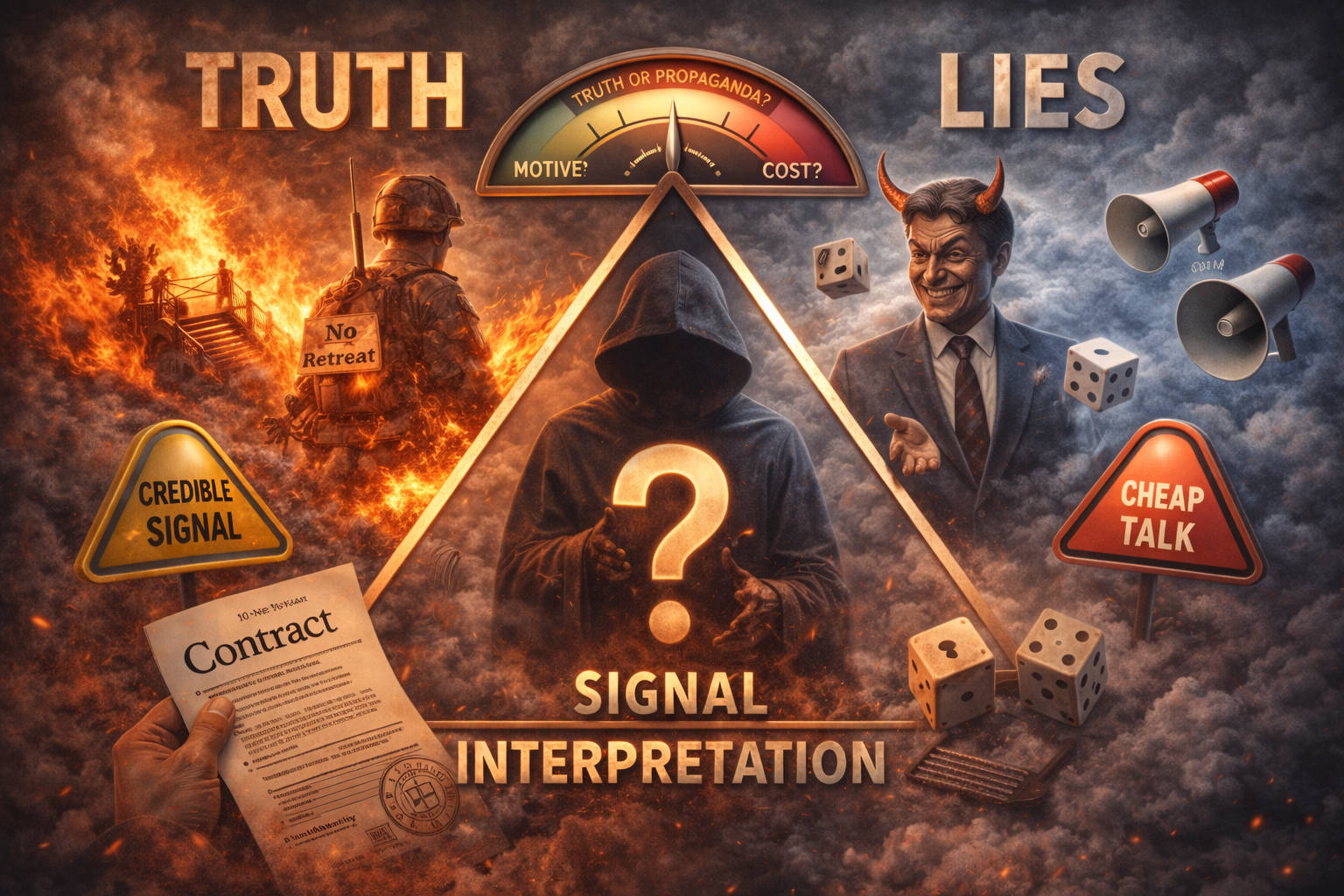
In any strategic interaction, information is power. However, because information is valuable, players have a rational incentive to lie, exaggerate, or omit the truth to manipulate the other side’s behavior. The Signaling Game is the study of how players communicate their hidden “types” or intentions when trust is absent.
The most important distinction in this game is between Cheap Talk and Credible Signals.
- Cheap Talk: The Noise of the Game
“Cheap Talk” refers to any communication that costs the sender nothing to produce. This includes PR statements, corporate mission statements, or a politician saying, “We are evaluating all options.”
The Logic: If a signal is free, everyone—regardless of their actual intent—will send it. Therefore, rational players should treat cheap talk as “noise” and assign it zero weight in their payoff calculations.
Application: In the music industry, a platform saying “we value creators” is cheap talk. It doesn’t cost them anything to say, and it doesn’t change their underlying incentive to extract as much margin as possible from those same creators. - Credible Signals: The Cost of Truth
For a signal to be credible, it must be costly. Specifically, it must be more expensive for a “liar” to send than for a “truth-teller.”
Burning Bridges: If a general burns the bridge behind his army, he is sending a credible signal to the enemy that he cannot retreat. The “cost” is the loss of his exit option. This forces the enemy to update their belief: they are now in a survival game, not a bargaining game.
The Warranty: A company offering a 10-year warranty is sending a credible signal of quality. A company with a bad product cannot afford to offer that warranty because the cost of repairs would bankrupt them.
Part 4 Reinforcement: The Reality Check
Before you act on a signal, you must run it through the Failure Point filters established in Part 4:
The Information Gap: Even a costly signal can be a “hallucination” if the sender is incompetent. If a leader burns their bridges because they have bad intelligence and think they are winning when they are actually losing, their “credible signal” doesn’t mean they are strong; it just means they are trapped by their own bad data.
Misidentifying the Game: You might see a company spending a massive amount of money on a “rebranding” and interpret it as a signal of long-term commitment. However, if they are actually in a Predatory Game (trying to look healthy enough to get acquired so they can dump the company on someone else), the “cost” is simply a marketing expense to facilitate an exit.
The Rationality Assumption: We assume people only send costly signals when it is optimal to do so. However, Spite or Pride are real human variables. Someone might “burn their bridges” not to win, but simply to ensure you lose with them. If you assume they are cold and rational, you will miss the fact that they have shifted from a game of “profit” to a game of “revenge.”
The Key Question
To cut through the noise, stop asking what they are saying and start asking: “What is the cost to this person if they are wrong or lying?” If the cost of being wrong is zero, you are listening to cheap talk. If the cost involves their reputation, their capital, or their future exit options, you are looking at a signal that can actually be used to update your strategy.


