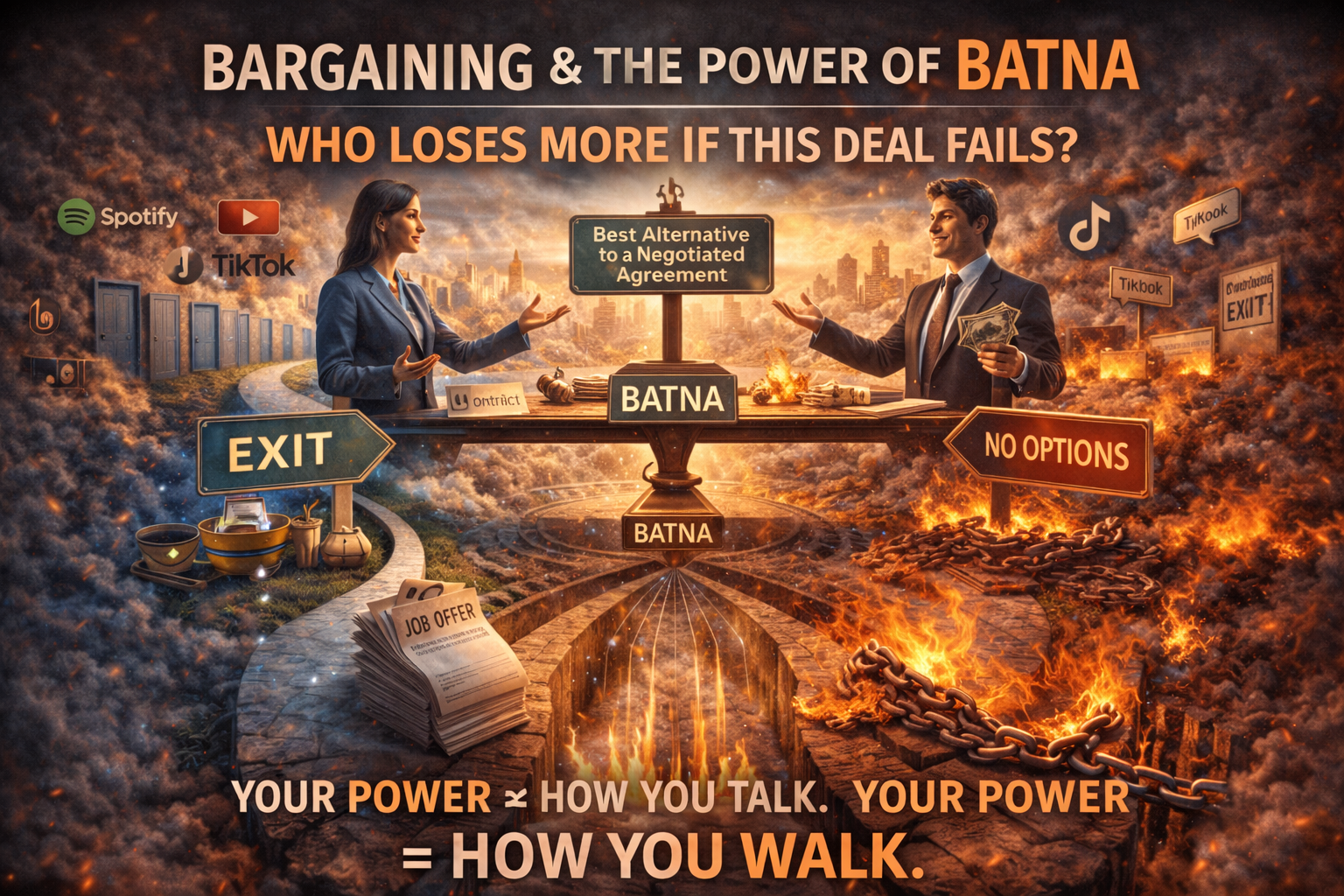
Your power in any negotiation—whether you are fighting for a higher salary, a record deal, or a diplomatic treaty—is not determined by how well you speak or how much you “deserve” a win. It is determined by what you do if the deal fails. In game theory, this is known as your BATNA (Best Alternative to a Negotiated Agreement).
- The Leverage of the Exit
The most fundamental rule of bargaining is that the player with the “best” outside option has the most leverage. If you have five other job offers, you can demand a higher salary because your “cost” of walking away is low. If you have no other offers, you are a “price-taker”—you must accept whatever the other side provides because your outside option is zero.
Application: Consider the power dynamic in creator-platform splits (like Spotify, YouTube, or TikTok). The platform has massive leverage because its outside option is “continuing to operate with millions of other creators.” The loss of one individual creator rarely affects their bottom line. However, the individual creator’s outside option is often “losing their entire audience and distribution.” Because the platform’s exit is cheap and the creator’s exit is expensive, the platform dictates the terms of the payoff matrix.
Part 4 Reinforcement: The Reality Check
Bargaining is rarely as clean as a math equation because the failure points of the model often hide the real leverage.
The Information Gap: Negotiations frequently fail or result in poor outcomes because of Asymmetric Information. You might think your boss has a great outside option (plenty of other candidates), but they might secretly be desperate to keep you because a specific project is at a breaking point. If you are working from a “hallucinated map,” you cannot accurately calculate your leverage. You might settle for less than you could have gotten, or push too hard and destroy a deal you needed.
The Rationality Assumption: We assume players will always take a deal that is even $1$ better than their outside option. However, human pride and spite are major variables. If a player feels insulted by an offer, they may rationally (in their own mind) reject a deal that is technically better than their BATNA just to “punish” the other side. If you treat your opponent like a cold calculator, you will be blindsided when they “flip the table” out of emotion.
Misidentifying the Game: You might think you are in a Win-Win Bargaining Game, where both sides want to find a middle ground. But your opponent might be playing a Predatory Game, where their goal isn’t to reach a fair deal, but to stall you until your outside options vanish, leaving you with no leverage at all.
The Complexity Ceiling: In complex negotiations (like a corporate merger), there are so many “moving parts” and stakeholders that a clear BATNA is impossible to define. The “game” becomes so cluttered with variables that players often revert to intuition or “cheap talk” because the math of the equilibrium has become too dense to solve.
The Key Question
To find your true power, stop looking at the deal on the table and look at the floor beneath your feet: “Who loses more if this deal doesn’t happen?” If the answer is you, you aren’t negotiating; you’re asking for a favor. If the answer is them, you hold the cards.


