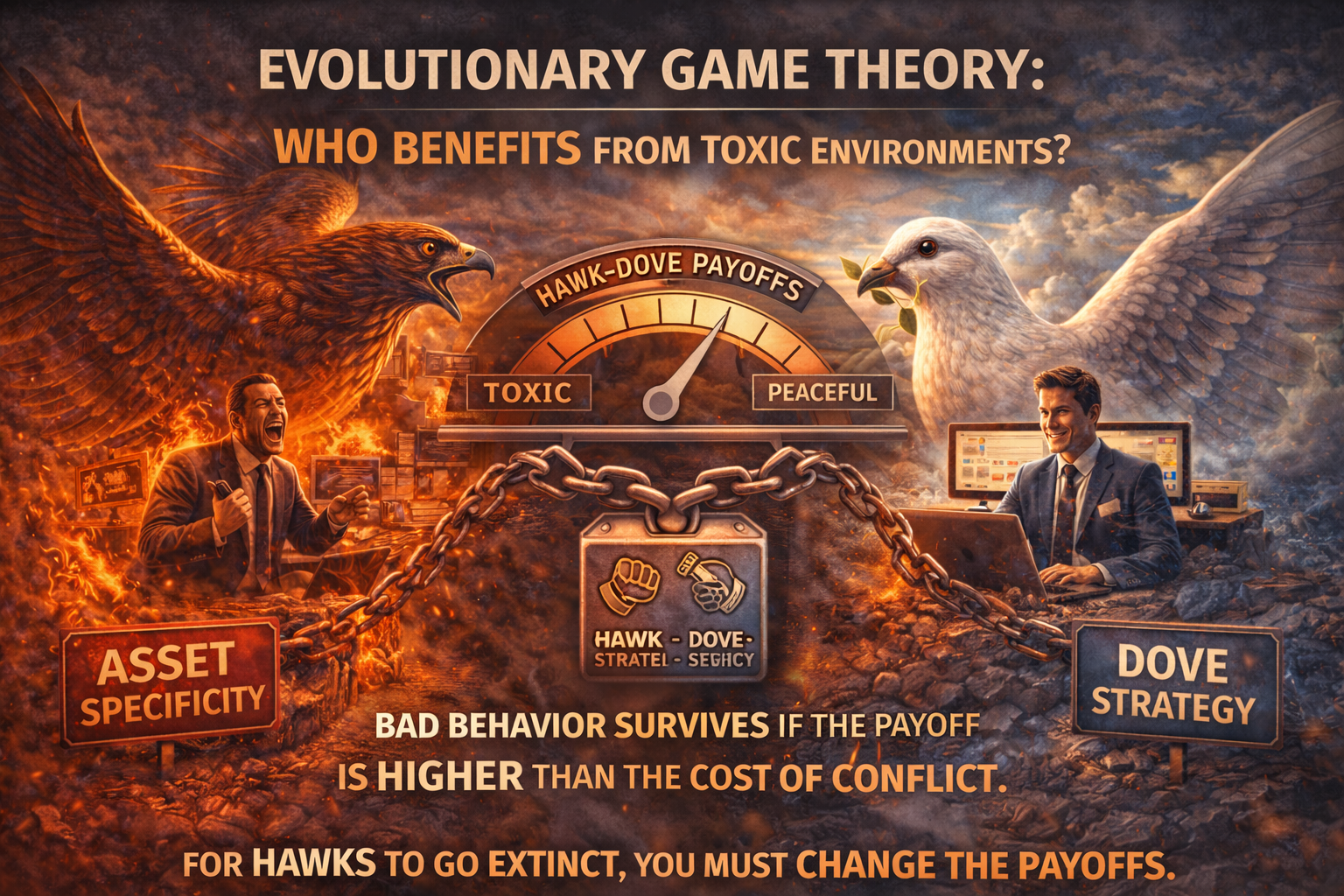
Evolutionary Game Theory (EGT) shifts the focus from a single “rational” decision to how strategies spread, survive, or die out across an entire population over time. In this model, “success” isn’t just a high score; it is persistence. If a strategy works, it is copied; if it fails, it disappears.
- The Hawk-Dove Balance
This is the canonical model for understanding social and competitive “mixes.”
Hawks always fight for resources. They win big against Doves but pay a high cost (injury/loss) when they fight other Hawks.
Doves share or retreat. They never pay the cost of a fight, but they lose resources to any Hawk they encounter.
Imagine a population of all Doves. It is a peaceful paradise—until one Hawk “invades.” That Hawk wins every encounter and thrives. However, if the population becomes entirely Hawks, they spend so much time hurting each other that a single Dove can “invade” and thrive simply by staying out of the way and collecting the “scraps.”
The result is an Evolutionary Stable Strategy (ESS): a “Stable Mix” of both behaviors.
Application: This explains why “toxic” behavior (the Hawk strategy) persists in corporate cultures or online comments. It isn’t a personality flaw; it is a strategy that survives because it extracts value from “Doves” who want to avoid the high cost of conflict. As long as there are Doves to exploit, the Hawk strategy will never go extinct.
Part 4 Reinforcement: The Reality Check
EGT is powerful for looking at the big picture, but it is highly susceptible to the “messy” variables of the real world.
The Limit of Equilibrium: In biology and business, the “mix” is almost never perfectly stable. We live in a constant state of disequilibrium. A new “strategy”—like a change in platform algorithms, a new law, or a disruptive AI bot—can “flip the table” and cause a mass extinction of old strategies. What was a “stable” corporate culture for 20 years can collapse in 20 minutes when the environment changes.
The Rationality Assumption: EGT actually removes the need for players to be “smart,” but it replaces it with the assumption that the environment is consistent. If the environment is chaotic (Part 4’s “Open Game”), a strategy that was “winning” yesterday (like being a loud, aggressive Hawk on Twitter) might become a “losing” strategy today because the platform changed the “payoff” for engagement.
The Complexity Ceiling: In a real ecosystem, there aren’t just two strategies (Hawks and Doves). There are millions. When the complexity gets too high, the “Stable Mix” becomes impossible to predict. You aren’t playing a game of Rock-Paper-Scissors; you’re playing Rock-Paper-Scissors-Lizard-Spock with ten thousand other variables.
Misidentifying the Game: You might think you are observing a Hawk-Dove game, but you might actually be looking at a Signaling Game (Part 5). Someone might be acting like a Hawk (cheap talk) to avoid a fight, but if you actually challenge them, they fold immediately. If you misidentify their “type,” you’ll play the wrong strategy and lose a resource you could have easily won.
The Key Question
When you see a “bad” behavior or a “toxic” environment that won’t go away, stop asking why people are being mean and start asking: “Does this environment reward the Hawk or the Dove?” If the environment makes it “profitable” to be a Hawk, no amount of moralizing will change the behavior. You have to change the payoffs.


