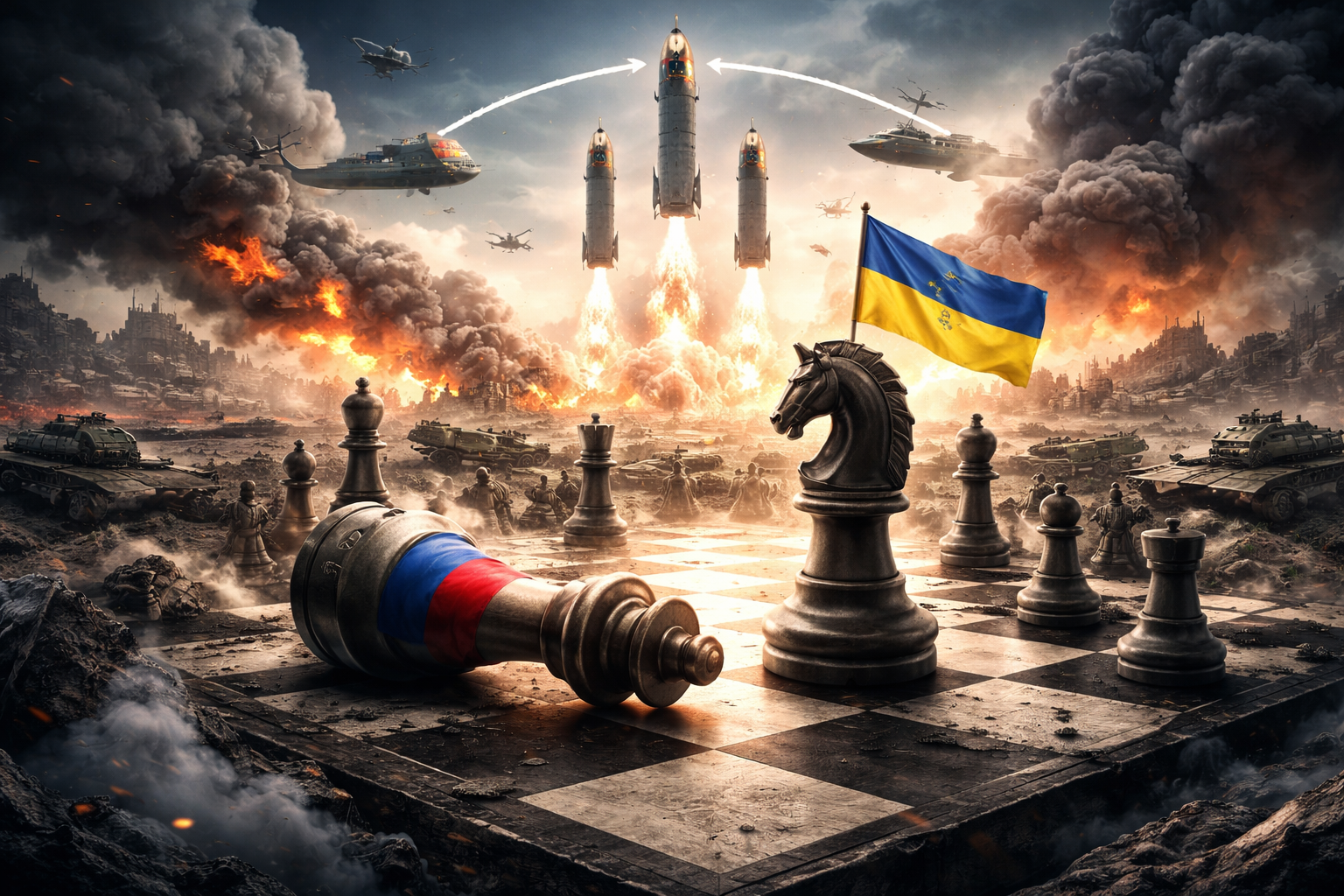
When game theory moves from the auction house to the battlefield, the stakes shift from dollars to national survival. The 2022 invasion of Ukraine serves as a primary example of how strategic miscalculations and equilibrium shifts can determine the course of history.
The Logistics Trap: One-Shot vs. Repeated Games
The initial Russian failure to capture Kyiv is often cited as a logistical blunder, but game theory reveals it as a failure of game selection.
Russia began the invasion playing a One-Shot Game. The strategy was a “blitz” designed for an immediate payoff: shock the leadership, seize the capital, and force a collapse within 72 hours. Because they expected the game to end quickly, they did not invest in a “logistics tail”—the trucks, fuel, and repair units needed for a prolonged fight.
Ukraine, however, refused to play that game. By surviving the first 72 hours, they forcibly transitioned the conflict into a Repeated Game (or a game of attrition). In a repeated game, the payoff matrix changes:
Initial Move: Speed and surprise are high-value.
Subsequent Rounds: Sustainability, resupply, and morale become the dominant variables.
Because Russian units were optimized for a sprint, they “stalled out” when the race became a marathon. A tank with no fuel is no longer a strategic asset; it becomes a liability that is often abandoned or captured, flipping the payoff in favor of the defender.
The Decapitation Paradox: Why Killing Leaders Fails
A common intuition is that a “decapitation strike”—killing the top government officials—will end a war instantly. Game theory explains why this is often a fallacy in nationalist conflicts.
For decapitation to work, power must be centralized and personal. If a nation’s identity and command are decentralized, killing a leader does not collapse the system; it removes the focal point for negotiation.
When a leader like Zelenskyy stays and survives, he acts as a “Schelling Point”—a natural focal point for coordination. If he were removed, the resistance wouldn’t necessarily stop; it would simply fracture into dozens of independent insurgencies. For the invader, this is a worse outcome: instead of negotiating with one person to end the war, they must now fight a “thousand-headed hydra” where no single surrender can stop the violence.
Nuclear Deterrence: Mutually Assured Destruction (MAD)
The reason the United States and NATO have not entered the war directly is found in the Nash Equilibrium of MAD.
Thomas Schelling, a Nobel laureate in game theory, proved that for deterrence to work, a threat must be credible. Nuclear powers ensure credibility through Second-Strike Capability—the ability to retaliate even after being hit first (often via submarines or hidden silos).
In the Ukraine conflict, the equilibrium looks like this:
Direct NATO Entry: High probability of conventional victory, but carries a non-zero risk of Russian nuclear escalation.
Proxy Support: Lower probability of immediate victory, but keeps the risk of nuclear war near zero.
Because the cost of nuclear war is “infinite,” even a tiny 1% or 5% chance of escalation dominates the decision tree. Rational actors (like the U.S. and Russia) therefore stay within the “limited war” equilibrium to avoid the catastrophic payoff of total annihilation.
The Irreversibility of Violence
Finally, game theory explains why wars become harder to end the longer they last. Early on, a conflict is a Bargaining Game over territory or policy. However, once large-scale civilian casualties occur, it becomes a Survival Game.
If a population believes that surrender leads to their cultural or physical extinction, resistance becomes the dominant strategy, regardless of the cost. Once a “surrender equilibrium” is destroyed by excessive violence, the attacker loses their leverage. Threats no longer work because the victim believes they will suffer whether they comply or not. At that point, the only way the game ends is through the total exhaustion of one side’s resources.


